
Radix Institute
History of RadixRadix® Work, it’s History, it’s Roots
Radix theory is rooted in the work of the psychiatrist Wilhelm Reich, who in the first half of the 20th century recognized a ‘functional identity’ between the body and mind. He saw that the mind and body are interrelated and that whatever is happening in one is also reflected in the other. Reich saw the body as a ‘frozen history’ of our life experiences and therefore a direct link to the unconscious material. Thus, whether psychotherapy takes place primarily at a body level, a mental level or an emotional level that work will impact at all three levels.
One of Reich’s fundamental concepts was of the life force which flows through the body and links mind, body and emotion. The founder of Radix, Dr. Charles Kelley, an experimental psychologist and forward thinker, expanded this concept. He named this life force the “radix,” meaning root or source. Kelley saw the radix as the energy flow underlying body, mind and spirit and that working with it means working with all three levels. Kelley also explored the relationship between emotion, vision and perception, bringing an important and unique therapeutic concept and tool to Radix work.
Radix is a process-oriented somatic psychotherapy and bodywork, meaning that therapists connect with the client at the start of each session and develop the session based on what is happening for the client – cognitively, physically and emotionally – at that moment. A process orientation facilitates the unfolding of these dimensions by freeing the flow of the radix which in turn develops aliveness, insight, self awareness, discovery, resolution and acceptance, the fundamental goals of most psychotherapies.
Excerpt from “Our Reichian Roots”
“Reich’s legacy lives on in a multitude of disciplines in the mind/body arena, now in the second and third generations since his death in 1957. Radix was blessed with the first-generation experience of its Founder, Charles Kelley, just as Bioenergetics was founded by a first-generation student of Reich’s, Alexander Lowen, and Gestalt Therapy by Fritz Perls. The Human Potential Movement of the 1970’s produced pioneers and disciplines that moved from classic “medical/psychiatric-model” orientation to mainstream “growth” models, and made the work of Reich, among others, accessible to countless numbers of people who were not “sick” but wanted to deeply change and enrich their lives. Kelley has written extensively about why he dissociated from Reich’s medical model with its focus on “sickness” and “cure,” just as he has explained his separation from Orgonomy, which freed him to develop Radix Education’s concepts and programs.
After Reich’s untimely death in prison in 1957, the Reichian movement fell into shock and confusion, and it was several years before a semblance of continuity emerged among his followers. As we honor the man to whom we are so indebted in this 50th Anniversary year of his death, we celebrate the resurgence of his work worldwide, the 1,950,000 results from a Google search for him, and the programs of the American College of Orgonomy and the Wilhelm Reich Museum. Above all, we are proud of our own role in applying his work to help people and the planet. Our enduring gratitude to you, Dr. Reich.” – Erica Kelley
It Started with Wilhelm Reich
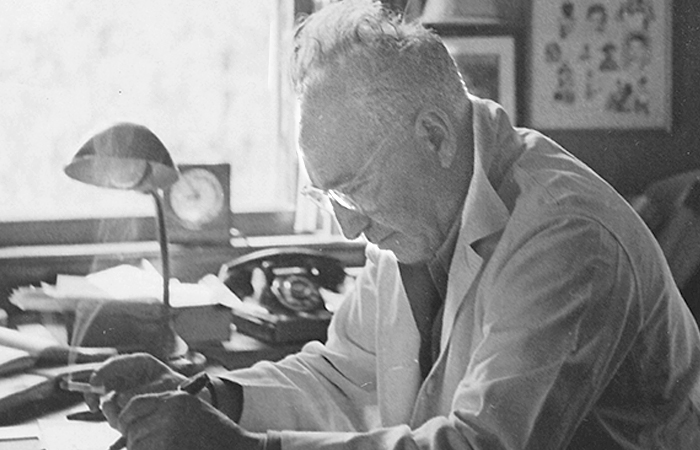
Reich believed that we needed to develop a whole new concept of sexuality. by Elsworth Baker, M.D.
As energy increases, the body regularly builds up tension.
Reich believed that, from the time of birth...
The healthy person does not need as much sexual outlet as the armored because he receives satisfaction and is not forever trying to attain it. He can then find joy in his work, which becomes more productive. He is faithful to his mate as long as he is satisfied. When he is no longer satisfied, he finds a new love and new satisfaction rather than remaining compulsively within a loveless marriage. Today, we have numerous manuals on sex with photographs of different positions and techniques designed to enable compulsive marriage partners to find some enjoyment in their sexual relations with each other. This is all a frantic effort to perpetuate our system and make it work. When excitation with one’s partner is lost, usually no amount of training or technique will revive it. When excitation is there, each individual knows what to do. This mutual excitation may last a lifetime or it may disappear in a night, depending on other factors that the two have in common. For this reason, it is well that the two know each other well and live together for a time before marriage is contemplated. It may take time before the sexual experience is satisfying to both. Men are inclined to climax prematurely in a new relationship, and the woman does not then have an opportunity for sufficient stimulation. She usually requires more time than the male to reach acme and more foreplay before genital union.
Excerpt from: The Journal of Orgonomy,
Volume 20 Number 2 The American College of Orgonomy